

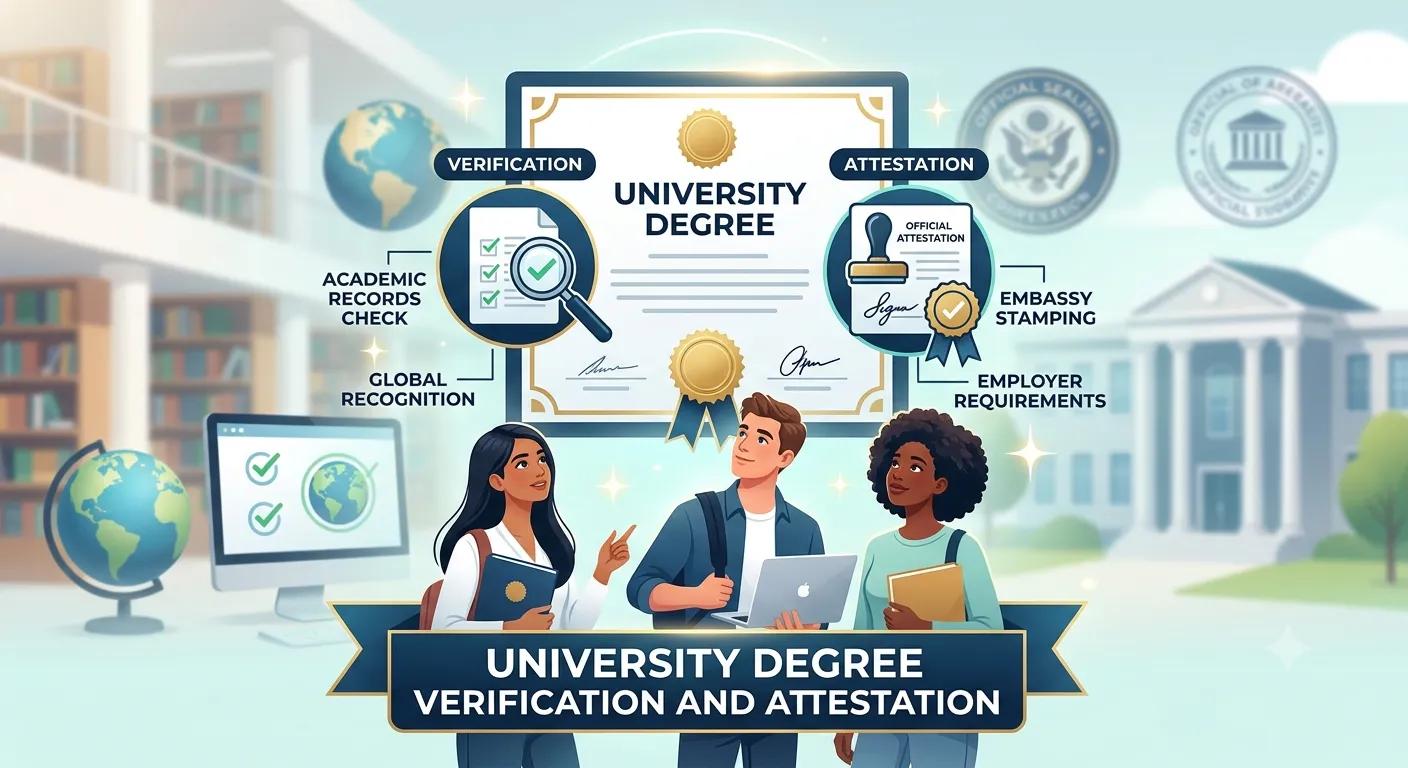
Planning to study, work, or settle abroad often requires students to submit their educational documents for degree verification and attestation. Universities, employers, immigration authorities, and government departments may ask for proof that a degree certificate is genuine and was issued by a recognized educational institution.
Understanding the difference between degree verification, authentication, apostille, and attestation can help students avoid delays and document rejection.
What Is University Degree Verification?
University degree verification is the process of confirming that a degree certificate was genuinely issued by the university or educational institution mentioned on the document.
During verification, authorities or authorized organizations may check details such as:
Student's name
Degree or course name
Enrollment or registration number
Year of graduation
Institution details
Certificate number
Academic records
University records and signatures
The verification process can vary between universities. Some institutions have online verification systems, while others require written requests or communication with their examination or registrar department. Certificate attestation in Mumbai
What Is Degree Attestation?
Degree attestation is the authentication of an educational document through the authorities required by the destination country.
The purpose is to establish that the document has passed through the necessary authentication channels and can be presented for official use abroad.
Depending on the destination country and purpose, the process may involve:
University Verification → State/Competent Authority Authentication → Ministry of External Affairs (MEA) → Embassy/Consulate → Destination-Country Authority
The exact process is not identical for every country.
Degree Verification vs Degree Attestation
Although these terms are often used together, they have different purposes.
Degree Verification | Degree Attestation |
|---|---|
Confirms that the university issued the certificate | Authenticates the document for official use |
Usually involves the educational institution | May involve government and diplomatic authorities |
Checks academic records | Confirms the authenticity of preceding authentication |
May be an early stage of the process | Usually forms part of the document legalization chain |
In simple terms, verification checks whether your degree is genuine, while attestation authenticates the document for use in another country. Kuwait Attestation in Pune
Why Do Students Need Degree Verification and Attestation?
Students may need authenticated educational documents for several purposes.
1. Studying Abroad
Foreign universities may ask for verified academic documents during admission or enrollment.
Depending on the country and institution, students may need to submit:
Degree certificates
Marksheets
Transcripts
Diploma certificates
Provisional certificates
Other educational records
Always follow the specific document requirements provided by the university.
2. Overseas Employment
Employers may request an authenticated degree certificate to confirm an applicant's educational qualification.
This can be particularly important for regulated professions or positions where educational qualifications are part of the employment or licensing requirements. Apostille Attestation in Chennai
3. Immigration and Visa Procedures
Some visa or immigration processes require authenticated educational documents. Requirements differ by country, visa category, and applicant circumstances.
4. Professional Licensing
Doctors, nurses, engineers, teachers, and other professionals may need verified educational qualifications before applying for professional registration or licensing abroad.
Common Documents That May Require Verification
The exact requirements depend on your purpose and destination, but commonly requested educational documents include:
Bachelor's degree certificate
Master's degree certificate
Diploma certificate
Provisional degree certificate
Marksheets
Academic transcripts
Consolidated marksheets
Transfer certificates
Other university-issued documents
Not every document necessarily needs the same authentication process.
Step-by-Step Degree Verification and Attestation Process
Step 1: Identify the Purpose of Authentication
First, determine why you need the document.
For example:
University admission
Overseas employment
Work visa
Immigration
Professional registration
Family sponsorship
The purpose can affect which authentication process is required.
Step 2: Check the Destination Country's Requirements
Different countries have different document legalization systems.
Before submitting your degree, check whether the destination country requires:
Apostille
Embassy or consular legalization
Attestation
Additional local authentication
Translation
Verification by a specific authority
Do not assume that the process used for one country will automatically work for another.
Step 3: Verify Your Degree With the University
The degree may need to be verified by the issuing university or an appropriate authority.
The university may confirm the academic information through its records.
If your university does not have an online verification facility, additional documentation or direct communication may be necessary. UAE Attestation in Chennai
Step 4: Complete State-Level Authentication if Required
For Indian educational documents, state-level authentication or verification may be required depending on the document and applicable procedure.
The relevant authority can vary according to the state and type of certificate.
Step 5: MEA Authentication or Apostille
The Ministry of External Affairs (MEA), Government of India, provides document authentication and apostille services for documents intended for use abroad.
Whether an apostille or another form of authentication is appropriate depends on the destination country and intended use.
Step 6: Embassy or Consulate Legalization
If required by the destination country, the authenticated document may then need to be submitted to its embassy or consulate in India.
Requirements can vary by country and document type.
Step 7: Final Authentication in the Destination Country
Some countries require a final authentication step by a local foreign affairs ministry or another government authority after the document reaches the destination country.
For example, certain UAE document-use processes can include authentication by the UAE Ministry of Foreign Affairs.
What Can Cause Degree Verification Delays?
Students should be aware of several issues that can slow down the process.
Name Mismatch
A difference between the name on the degree and passport can lead to questions during verification.
University Verification Delay
If the university takes time to respond to a verification request, subsequent authentication stages may also be delayed. Kuwait attestation in Chennai
Damaged Certificates
Torn, heavily damaged, altered, or unclear certificates may require additional assessment.
Old Degree Certificates
Older certificates can sometimes require additional verification if records are not readily available through modern online systems.
Distance or Online Education
Some degrees obtained through distance or online education may require additional checks depending on the destination country's requirements.
Missing Supporting Documents
Submitting incomplete documentation can result in delays or the need to resubmit documents.
What If Your University Does Not Respond to a Verification Request?
If your university does not respond promptly, do not immediately assume that your certificate cannot be authenticated.
You can:
Contact the university's examination or registrar department.
Confirm the correct verification procedure.
Check whether the university provides an online verification service.
Provide additional academic records if requested.
Follow up through the appropriate official channel.
Ask the authority handling your authentication whether an alternative verification method is available.
The solution depends on the university and the requirements of the destination country.
Can a Provisional Degree Certificate Be Verified?
A provisional degree certificate can sometimes be verified, but whether it can be used for international authentication depends on the issuing institution and destination-country requirements.
If you have not yet received your final degree certificate, check with the organization requesting your documents before beginning the process.
Do Marksheets Need to Be Attested?
Not always.
Some universities, employers, or immigration authorities require only the final degree certificate, while others may request marksheets or academic transcripts as supporting documents.
Students should obtain a written document checklist whenever possible so that unnecessary documents are not submitted. Kuwait Attestation in Pune
Frequently Asked Questions
Is university verification the same as attestation?
No. University verification confirms that the educational institution issued the document, while attestation or legalization authenticates the document through the authorities required for its intended use.
How long does degree verification take?
There is no universal processing time. It depends on the university, verification method, document type, and whether additional authentication is required.
Can I get my degree attested without university verification?
It depends on the document and destination country. Some processes require verification before further authentication, while requirements vary by jurisdiction.
Do I need the original degree certificate?
Many authentication procedures require the original document, but requirements vary. Check the current instructions applicable to your destination and document type.
What should I do if my degree has a spelling mistake?
Try to correct the error through the issuing university before beginning authentication. A mismatch between your educational document and passport can create complications during verification or acceptance.
Can I verify an old university degree?
Yes, an old degree may still be verifiable, but the process can depend on whether the university retains the relevant academic records and what verification methods it currently provides.
Conclusion
University degree verification and attestation are important steps when educational documents need to be used internationally. Verification establishes the authenticity of your academic qualification, while attestation or legalization helps authenticate the document for acceptance in the destination country.
Because requirements differ by country, university, document type, and purpose, students should always check the latest official requirements before submitting their original certificates. Starting the process early and ensuring that your documents contain accurate, consistent information can help reduce avoidable delays.